teapot1

teapot1

Friday, April 12, 2013


K


Kahlo


Now we come to the first woman artist in my A-Z list, and fascinating one. Frida Kahlo is one of Mexico’s greatest painters, who was married to another one, Diego Rivera, in a stormy relationship that saw them married, divorced, remarried, unfaithful to each other, and often living apart.


 Frida Kahlo and Diego Rivera
 

Kahlo is best known for her self-portraits, largely due to the isolation she experienced in her youth. She suffered from polio as a child, and in adolescence was severely injured in a bus accident that left her in pain and poor health her whole life. As an artist, she painted her pain into her pictures, particularly her self-portraits. Some of them are uncompromising and startling, such as “The Broken Column”:


Her bright colors and primitive style express Mexican culture, as does her use of monkeys and colorful birds.


Frida and Diego were communists, and they became friendly with Leon Trotsky, who they met when he received asylum in Mexico. He and Frida had an affair (though both were married at the time). Trotsky spent time living with both of them before he was assassinated in Mexico.
 
Frida Kahlo died at the age of forty-seven, possibly from complications of her various injuries and illnesses.


She has gained worldwide popularity since her death. She was honored with a U.S. postage stamp in 2001, the first Hispanic woman to be so recognized. Salma Hayek played her in a 2002 movie, Frida, and she and Diego are major characters in Barbara Kingsolver’s novel The Lacuna (2009).


Thursday, April 11, 2013

J Japonisme


J


Japonisme


Japonisme refers to the influence that Japanese art had on Western art in the late nineteenth century. Japan, formerly a closed society, was opened to the world in 1854, and Japanese art became wildly popular throughout Europe. Many impressionists and postimpressionist artists were inspired particularly by Japanese woodblock prints, known for their delicacy of line and color, lack of perspective, and  treatment of the natural world.


Hokusai, The Wave 


One of the artists most influenced was Vincent van Gogh, who did many paintings in the style of Japanese woodblock prints. 
 

Vincent van Gogh, after Japanese artist Keisai Eisen


Following are woodblock prints by the great Japanese artist Hiroshige and van Gogh’s own interpretations of them.


(Left--Hiroshige's Thunderstorm; right--van Gogh's The Bridge)


(Plum Blossoms: left, Hiroshige; right, van Gogh)

Wednesday, April 10, 2013


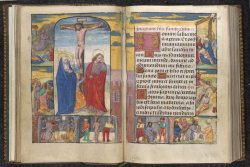
Illuminated manuscripts


Today’s post is sort of part 2 of yesterday’s post on historiated initials, because the initials are just a part of the art of manuscript illumination. This amazing and awe-inspiring art is one of my particular passions.


They were produced largely in the Middle Ages as aids to worship for the wealthy, royalty, and nobility. A variety of types of manuscripts were produced, among them Bibles, psalters or books of psalms, hymnals, and particularly Books of Hours, which were used for personal worship.


The images in the books are known as miniatures. The colors were made from materials as varied as minerals, plants, and insects (not very pleasant to think about). They were often commissioned by wealthy donors, and portraits of these donors were often included  among the miniatures in the book; for example, the donor might be shown kneeling at the cross of Christ.


These mostly unknown artists of the Middle Ages mastered the precise rendering of details, incorporated both reverence and humor (usually in the marginalia, small images of animals, peasant scenes, and grotesques), and stunning use of color.  Looking at them now, we can  understand why these books were so important to worship during medieval times; contemplating these beautiful images can put you into a meditative state and bring your mind to the majesty of God.

 
 A "grotesque" marginalia

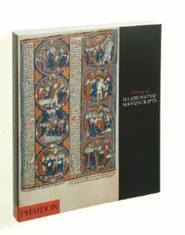
Original illuminated manuscripts from the Middle Ages still exist and are in collections ranging from libraries to museums to private. Fortunately for those of us who love them, reproductions are available in book form and as prints. I have a few reproduced Books of Hours, as well as catalogues from museum exhibitions. If you want to splurge, single pages from original manuscripts are available for purchase from dealers; I was lucky to obtain one at a reasonable price at an antiquarian book show. There is also a good selection of books on manuscripts in general; here are a few.


Tuesday, April 9, 2013


Historiated initials


If you’ve ever seen a copy of a medieval illuminated manuscript, you’ve probably noticed  that paragraphs and other sections of text begin with large, colorful letters. The most elaborate and beautiful of these contain paintings inside them that may comment on the text. These initials and illuminations in general (see tomorrow’s post) form an important genre of medieval art.


Initials that feature a portrait of an individual, like this P with St. Peter, are technically called inhabited initials, whereas those with pictures that tell a story, like the initial H with the Nativity scene at the beginning of this post, are known as historiated initials. Historiated seems to be applied more generally to all of them, though. Because of the elaborate style of the art in these letters, it’s sometimes hard to tell what letters they represent, though presumably the users of these manuscripts would have known, either from the picture or from the context.


Here are some more of these beautiful letters for you to enjoy.

A D with the Nativity
 
 
An S featuring a bishop


An O with the Crucifixion


Monday, April 8, 2013

FlashFiction Wednesday Challenge

Taking a break from A-Z to join Nicole's challenge this week.

The challenge is to write a flash fiction piece using the following photograph and the five words that are boldfaced in the story.


Inspiration


The smooth curves of the dome soothed her eyes the way violin music soothed her soul. She set her camera lens to its longest telephoto length, seesawing back and forth on the cork heels of her wedge sandals while she raised the camera to her eye, trying to get the right angle. She wanted a very close look at the iron rim running around the dome.
 
She started at the sight of the leering faces that seemed to stare at her in disapproval, as though she were trailing toilet paper from the hem of her skirt. Then she noticed the light behind one--and only one--of the small round windows. Why? she wondered.
 
It looked as though there was a warren of tiny rooms behind those windows. They were so close together that surely a light would show in all of them. She pictured a beehive of little cells, each complete in itself, but who or what could fit in them? What if those scary-looking faces were living gargoyles who each occupied one of those spaces at night? What if, in fact, they were the spirits of the architects, artists, composers who had built this city, centuries ago? What if they were angry at the changes the modern world brought to their masterpiece? What if they were plotting some kind of insurrection against the city? Or what if—what if someone only thought they were? An unstable, imaginative young woman with a romantic bent, someone like—herself?

            Her husband touched her arm. “Hey, what are you doing? I thought we were going to get dinner.”

            She turned and beamed at him.

            “What are you so excited about?”

            She took his arm. “I just found my next story.”
 
(289 words)

Guernica and the Garden


G


Guernica and Garden of Earthly Delights


Sorry to do this to you so soon after the disturbing Ensor painting, but G was too good to resist.
 

Art doesn’t have to be beautiful to be valuable or to be considered art at all. Some of the most powerful and meaningful works of art are nothing of the kind; their power comes from an ugliness through which the artist expresses a particular view of the world. Today I share two of the most famous pieces of what I like to call “stunning ugly art”.


Guernica, Pablo Picasso, 1937

 
This painting was Picasso’s response to the bombing of the town of Guernica in Spain during the Spanish Civil War. Picasso painted in tones of black, white, and gray, and the painting is terrifying and hypnotic. It shows a chaotic scramble of human and animal faces and bodies caught in the midst of screams of agony and bewilderment. It’s now recognized as one of art’s most powerful antiwar statements.


Garden of Earthly Delights,  Heironymus Bosch, early 1500s

 
This painting is actually a triptych, that is, a painting in three panels. The left panel shows God presenting Eve to Adam. Interestingly, although the three panels go together, this one is hardly ever depicted; most people will recognize the center and right panels, or at least images from them, because of their fantastic quality. The right panel depicts the landscape of Hell. The center panel has been interpreted as images of human lust and unresisted temptation, so that the whole picture can be seen as an allegory of the “fall of man.”  There are so many images in this painting that the viewer can’t begin to take them all in at once. A Wikipedia article about the painting explicates many of the details for those who’d like to go deeper into it.

 
Tomorrow, for those who stick with me, I promise something beautiful and sublime!

Saturday, April 6, 2013


F


Fauvism


Did you know there is an artistic term for the way Matisse paints--not just modernism or abstraction or expressionism? Fauvism was the first avant-garde movement of the 20th century. The term comes from the French les Fauves, which means “wild beasts.” The Fauves used bright, sometimes garish colors that often had no relation to reality; their forms tended to be unrefined and sometimes close to abstract.


As with most artistic movements, it began as a reaction against previous styles, in this case impressionism and more traditional ways of seeing; and, also like most new movements, it was not well received by critics and the art world at the time. The movement as such lasted only from 1904 to 1908 but much of its style echoed in expressionism, and it produced some of the world’s art masterpieces.

 
AndrĂ© Derain (1880–1954)


Maurice de Vlaminck (1876–1958)


Georges Rouault (1871-1958)